1. Overview
The Customer module is where the Admin or authorised user creates and manages customer records. Each customer captures identity, financial, review, compliance, and billing information. Customers are a key part of the Sell-side contract flow — once a customer is created, contracts can be raised against it.
Customer Billing & Cost Tracking Flow
In edit mode, two additional tabs become available: Contracts (listing all contracts linked to this customer) and Invoice Profile (used during contract creation to manage NDA signing and billing identity).
Prerequisites
- Platform Config must be completed (Organisation, User Management, Notification, Connectors).
- Regions must exist in Organisation → Catalogs (Type = Region).
- Departments must be created in the Department module.
- Commodities, Locations, and Users to Bill must be configured in Cost Center (required for the Billing tab).
- Notification templates must be configured in the Notification module (required for Review and Compliance tabs).
- Data Connectors must be configured in the Connectors module (required for Billing usage data).
- eSignature setup and NDA Template upload must be complete in Organisation → Settings and Templates (required for the Invoice Profile NDA signing flow).
2. Opening the Customer List
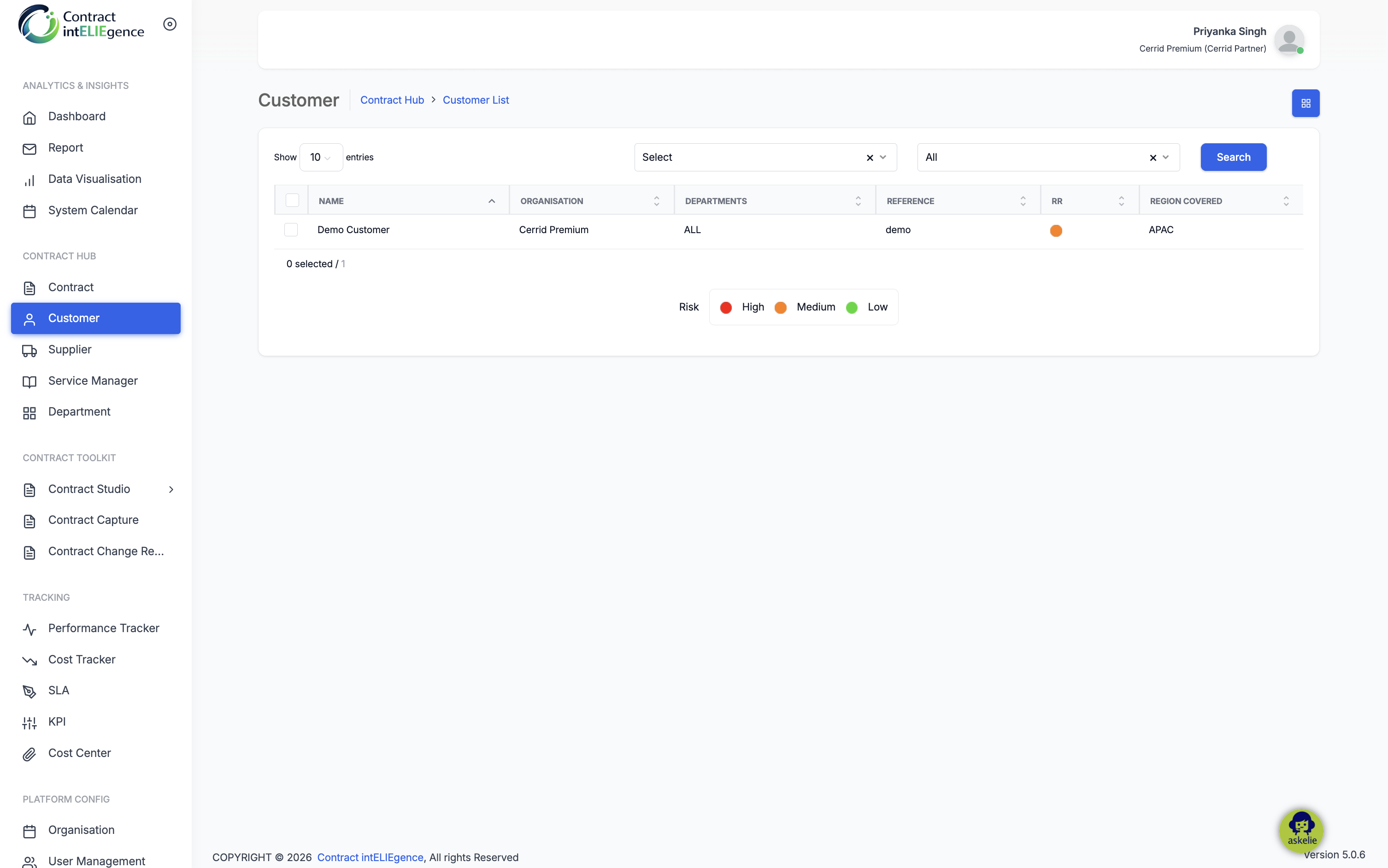
- In the left navigation, under Contract Hub, click Customer.
- The Customer List page shows all customer records. Each row displays key details including Name, Reference, Region, Risk Rating, and Start Date.
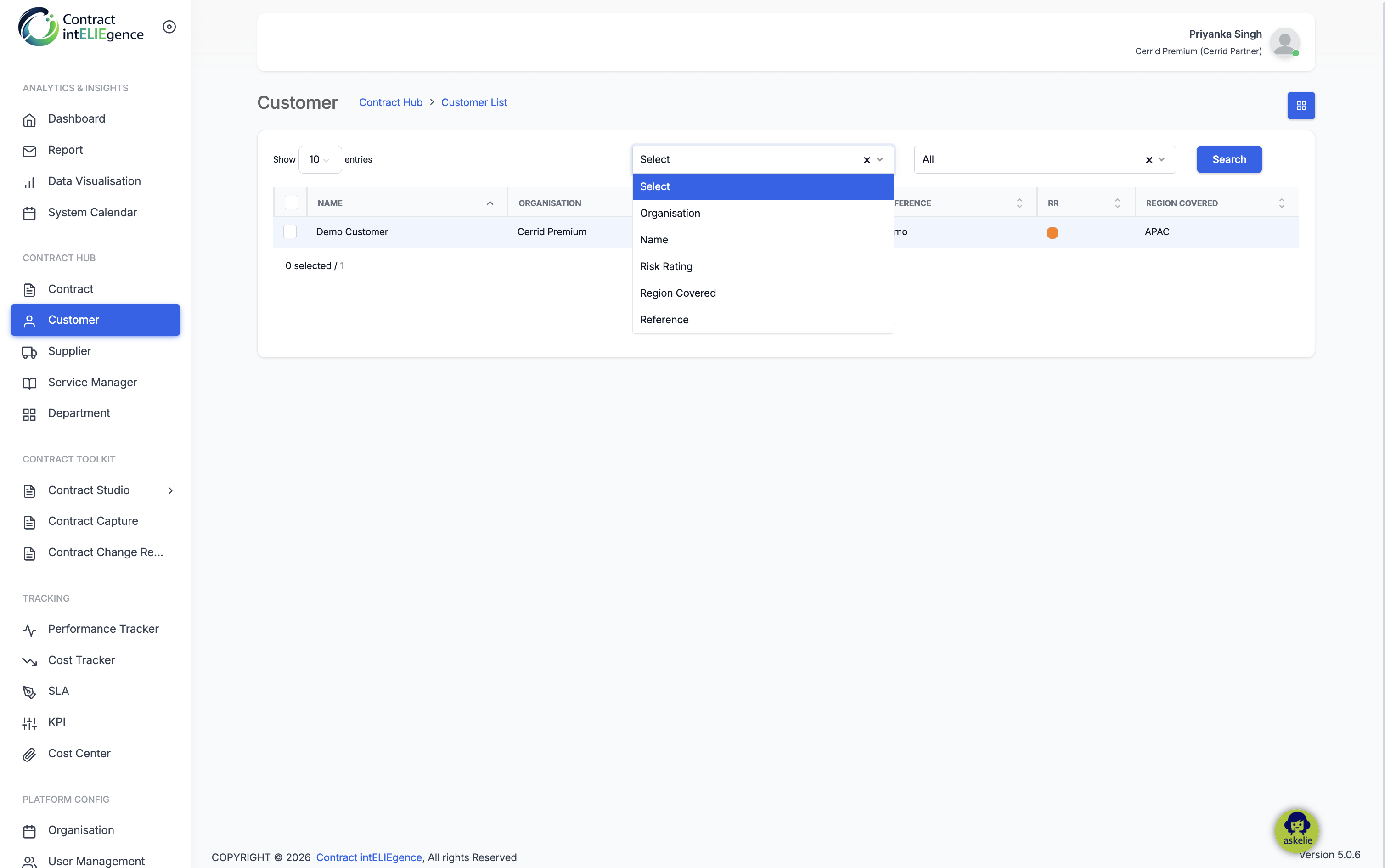
- Use Show entries, the filters and Search to locate a customer.
3. Adding a Customer
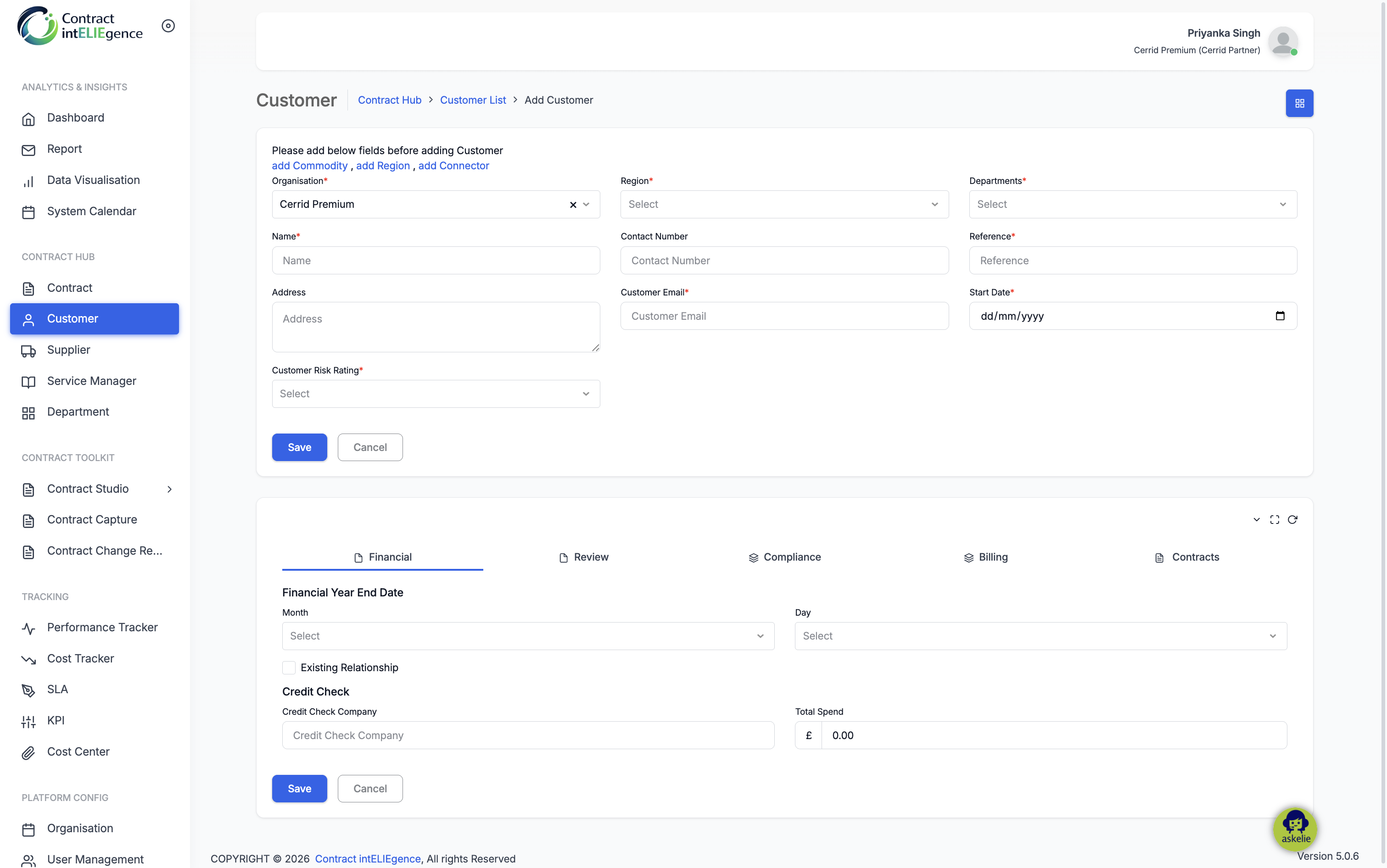
The Add Customer form has a top section for core details and a lower panel with tabs for Financial, Review, Compliance, and Billing information.
3.1 Core Details
- Click Add New on the Customer List page.
- Organisation is pre-selected based on your login.
- Select a Region (required) — sourced from Organisation → Catalogs (Type = Region).
- Select one or more Departments (required) — sourced from the Department module.
- Enter the customer's Name (required).
- Optionally enter a Contact Number.
- Enter a Reference (required) — a unique short code to identify this customer.
- Optionally enter an Address.
- Enter the Customer Email (required).
- Select a Start Date (required).
- Select a Customer Risk Rating (required) — Low, Medium, or High.
3.2 Financial Tab
Captures the customer's financial year end and credit check details.
- Select the Financial Year End Date — Month and Day.
- Tick Existing Relationship if this is not a new customer.
- Under Credit Check, enter the Credit Check Company name.
- Enter the Total Spend amount.
- Click Save.
3.3 Review Tab
Configure periodic reviews for this customer. The system automatically schedules review dates based on the start date and frequency, and sends email notifications to the reviewer.
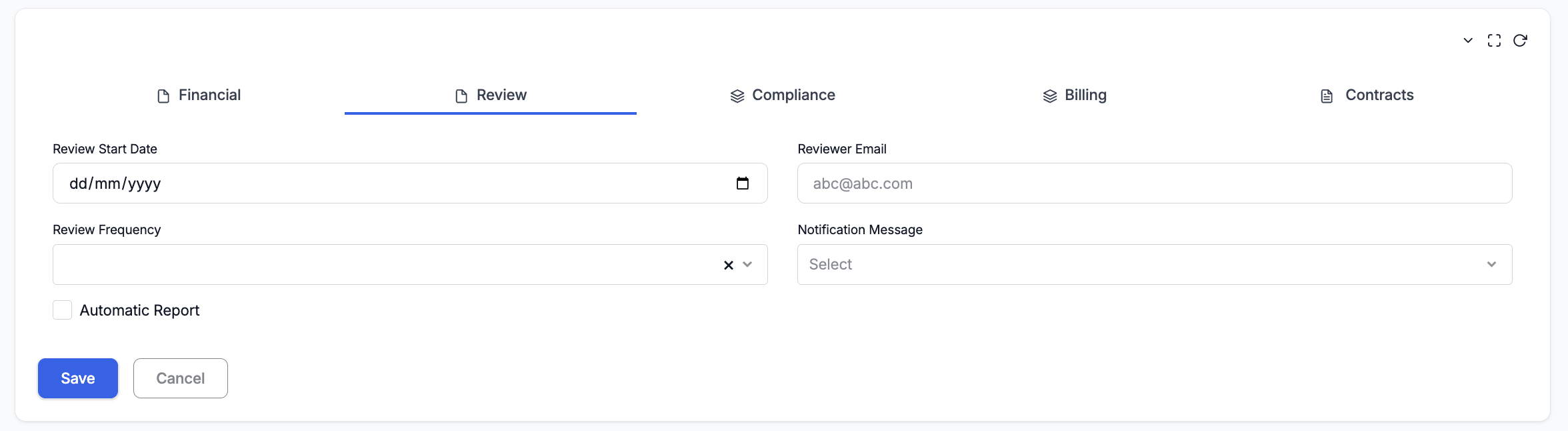
- Select a Review Start Date.
- Enter the Reviewer Email — the person who will receive the review notifications.
- Select a Review Frequency — 1 Month through to 12 Months. The system calculates the next review dates from the start date at this interval.
- Select a Notification Message — sourced from the Notification module. This is the email template sent to the reviewer.
- Optionally tick Automatic Report — when enabled, the system generates a customer performance report and attaches it to the review notification email. The reviewer receives both the notification and the report in a single email.
- Click Save.
3.4 Compliance Tab
Track compliance documents related to this customer (for example, certifications, insurance, regulatory approvals). Multiple documents can be added.
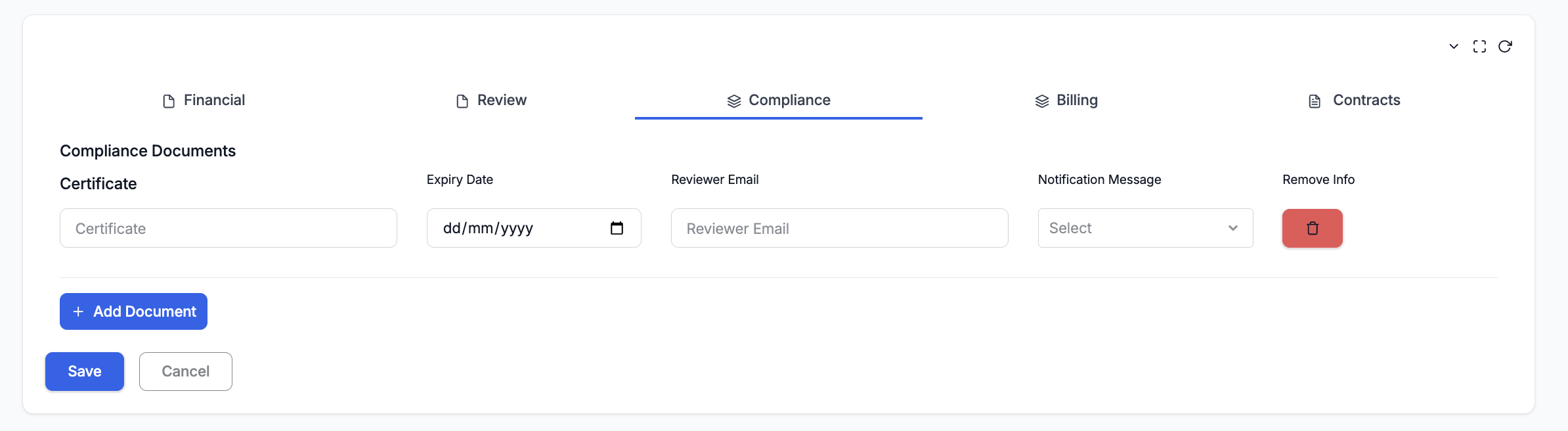
- Click + Add Document to add a compliance document row.
- Enter the Certificate name.
- Select the Expiry Date.
- Enter the Reviewer Email — the person who will be notified before expiry.
- Select a Notification Message — the email template used for the expiry notification.
- Repeat for additional documents as needed.
- To remove a document, click the red Remove button on its row.
- Click Save.
3.5 Billing Tab
Configure billing details for the customer. Items, locations, departments and users are sourced from the Cost Center and Department modules. Usage data is fetched from a Data Connector on a schedule and is further used in the Cost Tracker to generate costs.
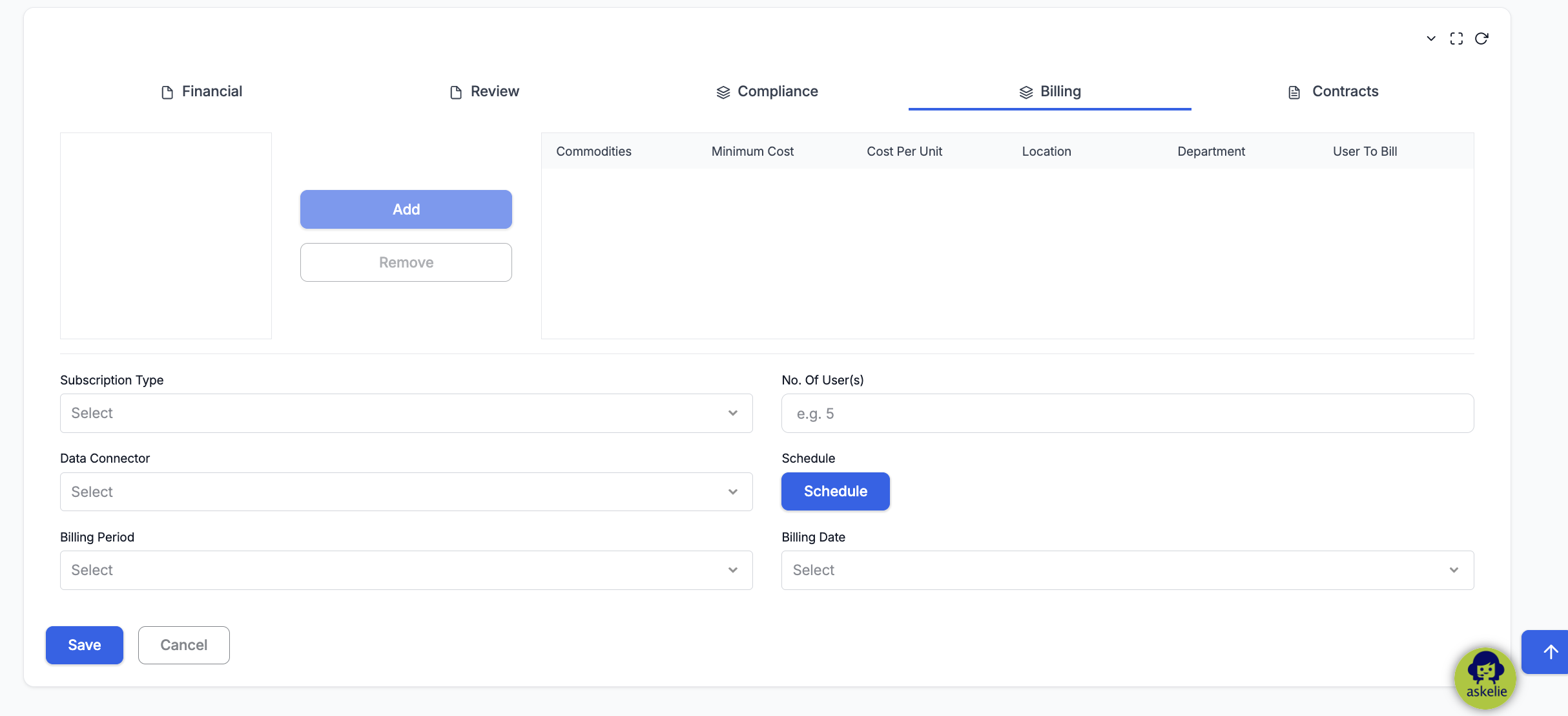
Commodities (left panel):
- Select one or more items from the left panel. These are Commodities sourced from Cost Center → Commodity.
- Click Add to move them to the billing table on the right.
- For each commodity in the table, enter the Minimum Cost and Cost Per Unit.
- Select a Location — sourced from Cost Center → Location.
- Select a Department — sourced from the Department module.
- Select a User To Bill — sourced from Cost Center → User to Bill.
- To remove a commodity, select it and click Remove.
Billing Configuration:
- Select a Subscription Type.
- Enter the No. Of User(s).
- Select a Data Connector — a Data Connector configured in Platform Config → Connectors. This defines which external database and table to read usage data from. The connector must be created and tested in the Connectors module before it appears here.
- Click the Schedule button to configure the data fetch schedule — this determines how often the system pulls usage data from the connected database. The Schedule popup lets you choose interval-based (every X minutes/hours) or time-based (daily, weekly, monthly, yearly) scheduling. See the Schedule Configuration section for full details.
- Select a Billing Period and Billing Date.
- Click Save.
When a customer is created, the system automatically creates a user account for the customer using the Customer Email and Name, with the role set to Customer. The customer receives login credentials and can sign in to Contract intELIEgence to view their own contracts and a dashboard filtered to show only their data. No manual user creation is needed — this happens automatically on Save.
4. Editing a Customer
Click a customer name from the Customer List to open the Edit Customer screen. All core details and tab data can be updated. In edit mode, two additional tabs become available:
4.1 Contracts Tab (Edit Mode Only)
Lists all contracts that have been created for this customer. This is a read-only view from the customer's perspective.
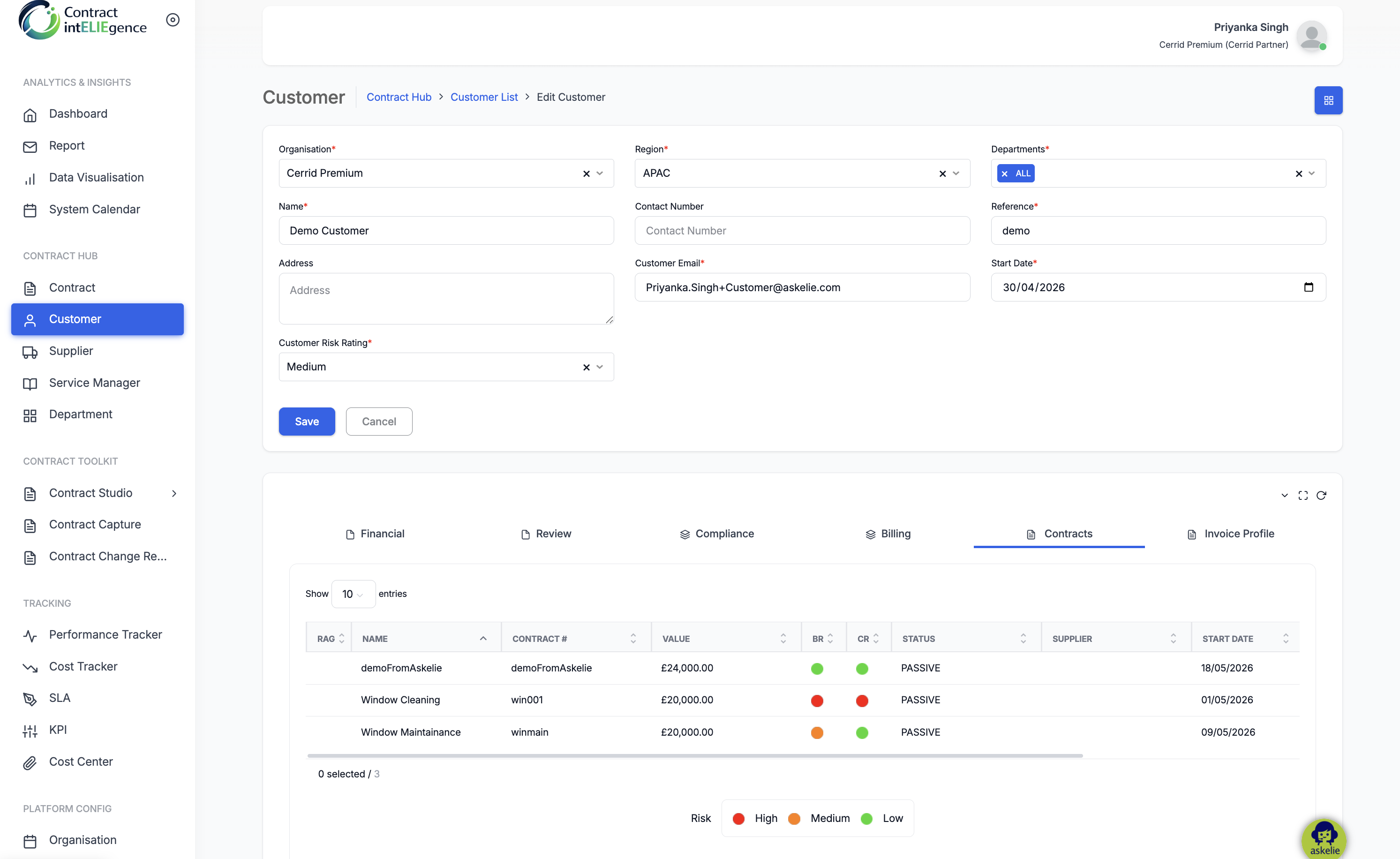
The table shows:
| Column | Description |
|---|---|
| RAG | Risk indicator — Red (High), Amber (Medium), Green (Low). |
| Name | Contract name. Click to navigate directly to the contract record. |
| Contract # | Contract number. |
| Value | Contract value. |
| BR / CR | Business Risk / Contract Risk indicators. |
| Status | Current contract status (e.g., Passive, Active, Draft). |
| Supplier | Associated supplier (if applicable). |
| Start Date | Contract start date. |
4.2 Invoice Profile Tab (Edit Mode Only)
Manages the invoice profiles for this customer. Invoice profiles are used during contract creation — when you select a customer while creating a contract, the relevant invoice profiles are listed for selection. Multiple contracts can share the same customer but use different invoice profiles.
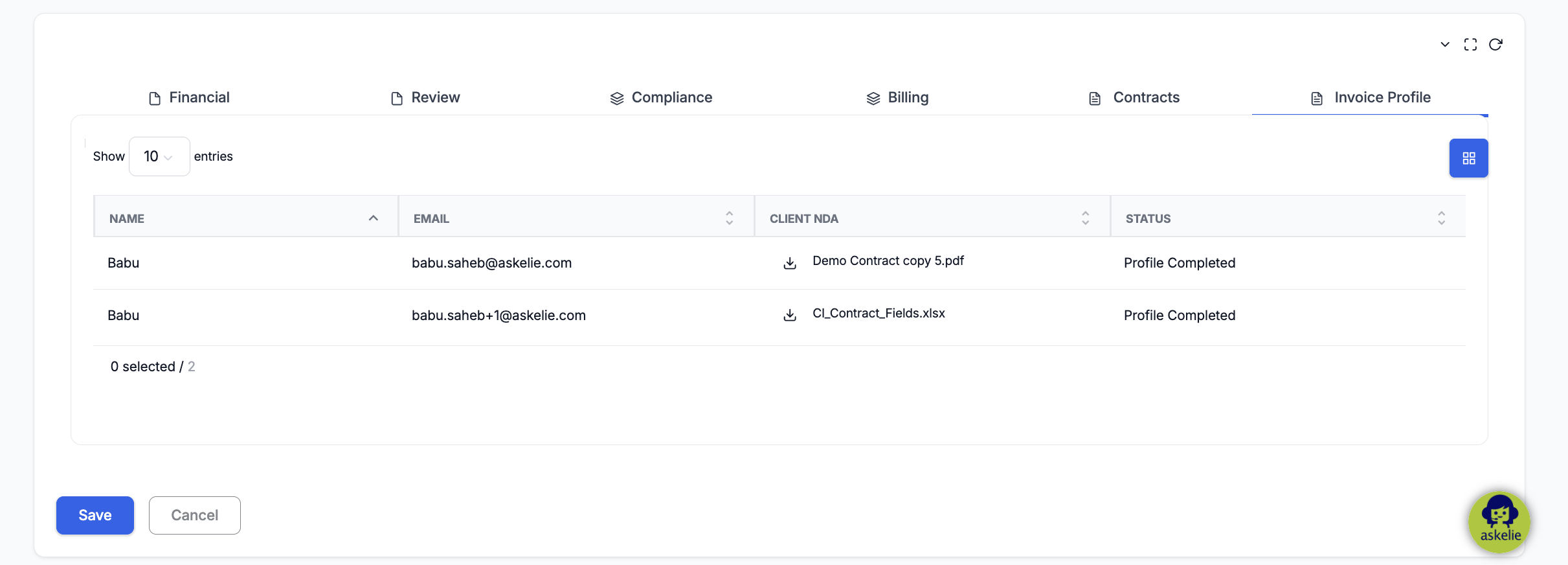
The table shows each profile's Name, Email, Client NDA (downloadable document), and Status.
The Status column reflects where the profile is in the NDA signing flow:
| Status | Meaning |
|---|---|
| Internal waiting | The NDA has been generated and sent for signature; awaiting the Organisation's designated signer, who signs first. |
| External waiting | The Organisation has signed; awaiting the Invoice Profile recipient (the profile email) to sign. |
| Profile Completed | All parties have signed, or an NDA was uploaded directly. The signed NDA can be downloaded, and a contract linked to this profile can go Live. |
| Signature Declined | A signer declined the NDA. The profile cannot be used until it is redone. |
| Error | NDA generation or sending failed; the column shows the error message describing what went wrong. |
4.3 Adding an Invoice Profile
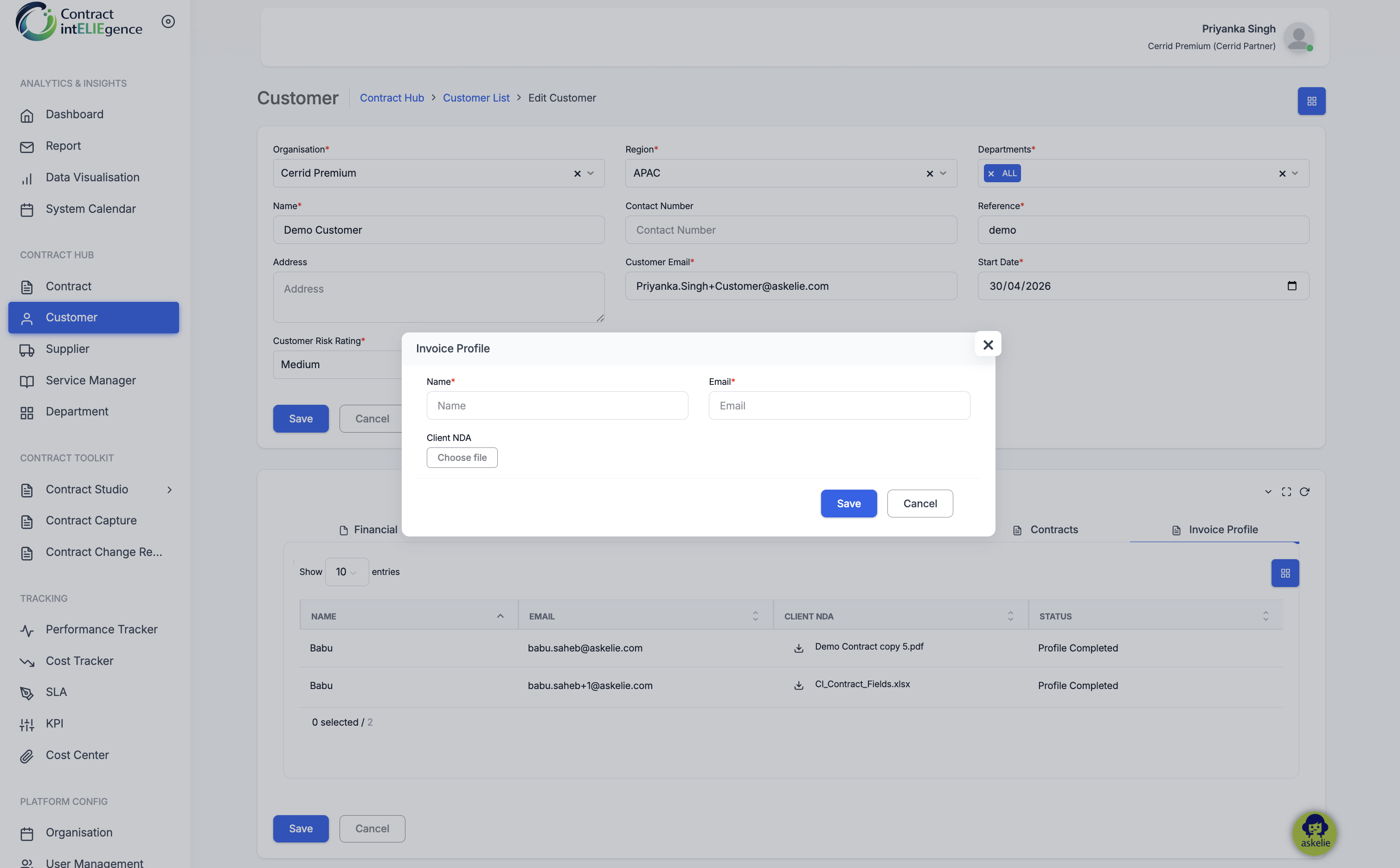
- On the Invoice Profile tab, click Add New.
- Enter the invoice profile Name (required).
- Enter the Email (required).
- Under Client NDA, attach an NDA document (max 5MB). This is optional if an NDA Template is configured in Organisation → Templates (the system generates and routes the NDA for you); if no NDA Template is configured, attaching a file is required.
- Click Save.
From the Invoice Profile tab you can also:
- Edit a profile — allowed only while it is not Profile Completed. Once completed, the Name, Email and NDA are locked.
- Download the signed NDA from the Client NDA column once the profile is Profile Completed.
- Delete a profile using the Actions column.
- If a file is attached during profile creation, no signing flow runs — you are supplying an already-signed NDA — so the profile status is set immediately to "Profile Completed".
- If no file is attached, the system triggers the NDA signing flow: an NDA is generated from the Organisation → Templates (NDA Template) and sent for e-signature in sequence — first to the Organisation's designated signer (status "Internal waiting"), then to the Invoice Profile email (status "External waiting"). Once both parties have signed, the status changes to "Profile Completed".
All documents sent for signature can be tracked in the Document Signature module.
- If the invoice profile linked to a contract has status "Profile Completed", the contract becomes Live.
- If the invoice profile is not yet completed (NDA still pending signatures), the contract remains in Draft mode. Once the profile is completed, the contract automatically moves to Live state.
5. Deleting a Customer
- On the Customer List page, tick the checkbox next to one or more customers.
- A Delete button appears.
- Click Delete and confirm.
6. Bulk Import
Contract intELIEgence allows you to import multiple customers at once using a pre-formatted Excel template. This is useful when migrating data from another system or when you need to create many customer records in a single operation.
6.1 How to Import
- On the Customer List page, click the grid icon in the top-right corner to reveal a dropdown menu with + Add and Import options.
- Click Import to open the Import dialog.
- Select an Organisation from the dropdown.
- Click Import Template to download the pre-formatted Excel template for customers.
- Fill in the Excel template with the customer data you wish to import (see the template columns below).
- Click Choose File to select the completed Excel file.
- Click Submit to import the records.
6.2 Import Template Columns
| Field | Description |
|---|---|
| name | Customer name. |
| reference | Unique customer reference code. |
| address | Customer address. |
| contactNumber | Contact phone number. |
| Customer email address. | |
| reviewStartDate | Review start date. |
| reviewFrequency | Review frequency (e.g. 1 Month, 3 Months). |
| reviewerEmail | Reviewer email address. |
| notificationMessage | Notification message template for reviews. |
| creditCheckCompany | Credit check company name. |
| risk | Customer risk rating (Low, Medium, High). |
| financialEndDay | Financial year end day. |
| financialEndMonth | Financial year end month. |
| relationshipNote | Existing relationship note. |
| startDate | Customer start date. |
| regionName | Region name (must exist in Catalogs). |
| department | Department name (must exist in Departments). |
7. Tips
- A customer account is automatically created on save — the customer can log in using their email and view only their own contracts and dashboard. Ensure the Customer Email is correct before saving.
- Set up Cost Center (Commodities, Locations, Users to Bill) and Departments before adding customers that need billing configuration.
- Configure Review frequency and Notification Message to automate periodic customer reviews.
- Add Invoice Profiles with an attached NDA file to skip the signing flow and move contracts to Live immediately.
- Use the Contracts tab in edit mode to quickly navigate to any contract linked to this customer.
- Track compliance document expiry dates — the system sends notifications to the reviewer before each document expires.
8. Troubleshooting
| Issue | Resolution |
|---|---|
| "Please add Commodity / Region / Connector" banner | Add the required items: Regions in Organisation → Catalogs, Commodities in Cost Center, Connectors in the Connectors module. |
| Region dropdown is empty | Add Region catalog items in Organisation → Catalogs (Type = Region). |
| Department dropdown is empty | Create departments in the Department module first. |
| Billing commodities list is empty | Add Commodities in Cost Center → Commodity. |
| Invoice Profile stuck on pending | Check that eSignature is configured in Organisation → Settings and that all parties have signed the NDA via the e-signature provider. |
| Contract remains in Draft | The linked Invoice Profile is not yet completed. Complete the NDA signing flow or attach a file directly to the profile. |
| Review notifications not being sent | Verify Outgoing Mail is configured, the Notification Message template exists, and the Reviewer Email is correct. |
| Contracts tab not visible | This tab only appears in Edit mode. Open an existing customer to see it. |